

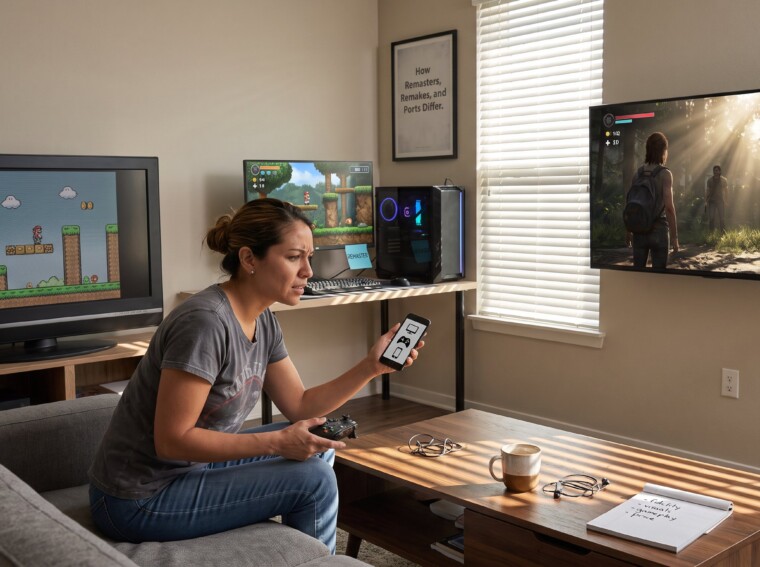
How Remasters, Remakes, and Ports Differ is the core question players ask when a classic returns. In 2026 more studios ship multiple versions of older games: the faithful port, an updated remaster, or a full remake. This guide explains those categories in plain terms, shows the practical differences players will feel, and gives a decision framework for which release to buy for PC, console, or mobile.
Key Takeaways
- Ports deliver the original game experience on new hardware with minimal changes, preserving gameplay and design exactly.
- Remasters enhance a game’s visuals and performance—like higher resolution textures and smoother framerates—without altering core gameplay mechanics.
- Remakes rebuild games on new engines, often changing mechanics, level design, and adding new content for a reimagined experience.
- Choose a port if you want nostalgia and exact gameplay replication; pick a remaster for modern polish with familiar gameplay; select a remake to enjoy updated systems and fresh design.
- Check technical details like engine upgrades or asset rebuilds to distinguish between ports, remasters, and remakes before purchasing.
- Awareness of these differences helps players make informed buying decisions, matching game versions to their preferences for authenticity, visuals, or modern features.
What Remasters, Remakes, And Ports Actually Mean
Fact first: a port, remaster, and remake are three distinct technical approaches to re-releasing a game. A port moves the original game to new hardware with minimal design change. Developers mainly adjust code and input mapping so the same engine and assets run on another platform. For example, a PlayStation 3-era shooter recompiled to run on modern consoles with the same levels and rules is a port.
A remaster improves the original game for current standards while keeping core design intact. Remasters raise resolution, replace low-res textures, improve audio mixes, and add modern UI and performance patches. The engine often remains the same or is lightly upgraded. Players get cleaner visuals and smoother framerates, but the level geometry, enemy placement, and pacing remain familiar. A remaster may fix 300 bugs and increase texture quality from 512px to 2K, but it won’t rewrite combat systems.
A remake rebuilds the game on new technology, often a different engine, and can change mechanics, level layouts, and pacing while preserving story and characters. Think of a remake as a new interpretation: new models, reworked AI, altered progression, and sometimes added or removed content. A remake can turn a 12-hour linear game into a 20-hour experience with new side content and mechanics.
Why this matters: the label tells players what to expect. A port preserves the original feel. A remaster polishes it. A remake reinvents it. Publishers may blur lines, marketing sometimes calls a remaster a “remake” to attract attention, so check technical notes and patch history before buying.
How They Differ In Practice: Technology, Gameplay, And Presentation
Quick answer: technology, gameplay, and presentation change progressively from port → remaster → remake. A port keeps the same engine and systems. A remaster upgrades assets and performance. A remake replaces engines and can redesign systems. Below are clear, concrete differences to watch for.
Technology: Ports typically use the original engine with platform-specific wrappers, which means the same physics and netcode persist. Remasters often patch the original engine with higher-resolution textures, new shaders, and CPU/GPU optimizations: they may add variable framerates (30→60 fps) or 4K output. Remakes usually move to a modern engine (Unreal, Unity, or in-house) that supports advanced animation, lighting, and AI. Example: a remaster might change textures from 1024px to 4K: a remake might rebuild animations with motion-captured data.
Gameplay: Ports preserve original mechanics: any changes are usually control mapping or bug fixes. Remasters keep core mechanics but can tweak balance and fix exploits, rarely add new systems. Remakes can alter combat, level design, enemy behavior, and save systems. Players should expect altered pacing: a remake may add cover mechanics or rework enemy encounters, turning tight arcade fights into slower, tactical encounters.
Presentation: Ports often look the same, possibly with updated UI elements. Remasters provide clearer visuals, cleaned up cutscenes, re-recorded audio, and better HDR handling. Remakes introduce new art direction, new models, and sometimes new voice actors.
Practical tips: if a release lists “engine rewritten,” treat it as a remake. If the changelog details texture, audio, and UI upgrades only, it’s a remaster. If the release emphasizes compatibility with new controllers but not visuals, it’s a port. Players tracking patch notes and publisher developer blogs will catch these signals: hobbyists can follow an ongoing feed of patches in the updates hub to see how a release evolves over time.
How To Choose Which Version To Buy Or Play
Direct answer: pick based on desired fidelity to the original, tolerance for changed systems, and platform needs. If someone wants the original experience exactly, buy a port. If they want the original with modern polish, choose a remaster. If they want a reimagined experience, go for a remake. The following decision checks help a buyer decide.
Check 1, Fidelity need: If nostalgia for exact level design, enemy patterns, or speedrun routes matters, a port is best. Ports preserve frame-timing quirks that speedrunners exploit. If those quirks vanish, a remaster or remake may break leaderboard runs.
Check 2, Visual and performance expectations: If a player values 4K textures, smoother framerates, and modern UI but wants the original systems intact, a remaster typically delivers. Remasters often remove stutters and bring stable 60 fps, which can reduce input lag by measurable milliseconds, useful on competitive titles.
Check 3, Desire for modern design: If someone prefers contemporary controls, updated AI, new content, or rebalanced difficulty, a remake is the right choice. Remakes can add new difficulty tiers, rework inventory systems, and expand narrative sequences. Expect to relearn tactics: an enemy that died in two hits in the original might need ten hits in a remake.
Check 4, Platform and price: Ports often cost less and appear across many systems. Remasters sit mid-range in price and occasionally bundle DLC. Remakes usually command premium pricing and longer development cycles. Watch for DLC and microtransactions: some ports re-release older DLC at extra cost, a practical issue reported in recent console ports.
Practical warning: marketing language can mislead. Confirm whether the release mentions “engine upgrade,” “asset rebuild,” or only “compatibility” to know what you actually buy. For readers who track release cadence or patch notes across platforms, the site offers a focused resource on timing and updates in the release tracker. For guidance on when patches change gameplay after launch, consult the short primer on update tradeoffs.
Conclusion
Insight: players win when they match version type to their priorities. Ports preserve original play: remasters polish without altering design: remakes reinvent. In 2026, studios choose formats for technical constraints and commercial reasons. Readers who define what they value, authenticity, visuals, or modern mechanics, will make smarter purchases and avoid buyer’s remorse.