

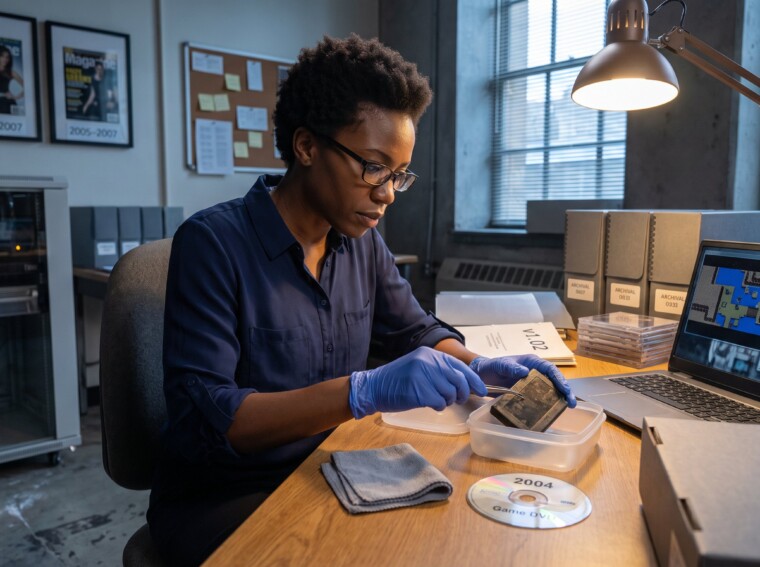
Older game versions matter because they hold playable records of design choices, community life, and technical states that vanish after updates. For gamers and researchers, a specific build can mean the difference between authentic experience and a rewritten memory. This article explains why preserving older game versions protects play, cultural meaning, and future innovation, and it points to concrete risks and rewards for players, scholars, and developers.
Key Takeaways
- Preserving older game versions is crucial as they serve as cultural artifacts that capture unique historical and design moments in gaming.
- Older game versions protect authentic player experiences and support research by providing stable artifacts for study and reproducibility.
- Technical decay, legal restrictions, and platform volatility pose significant challenges to maintaining access to older game versions.
- Archivists and hobbyists can employ specific methods like checksum verification and metadata management to securely preserve game builds.
- Developers benefit from preserved versions by repurposing past code and discovering new revenue opportunities through reissues and anthologies.
- Collaborative preservation efforts among players, studios, and archivists ensure the continuity of gaming culture and innovation for future generations.
The Cultural And Historical Value Of Older Game Versions
Fact first: older game versions are cultural artifacts with unique, time‑bound meaning. A 2004 build of a multiplayer map, a vanished UI from a 2010 RPG, or the pre‑patch balance of an esports title each capture a moment in gaming history. Those builds show what designers valued, what hardware enabled, and how players behaved.
Why this matters: film historians study raw negatives: musicologists keep original masters. In games, the “master” often disappears when a patch replaces files or a storefront delists a title. The result is lost evidence: the specific mechanics speedrunners learned, community mods that relied on a bug, or a local server culture that never got archived. For example, a single pre‑patch leaderboard snapshot can explain how a game’s economy broke and why a studio later nerfed a tactic.
Concrete value: researchers tracing monetization, scholars analyzing representation, and curators cataloguing aesthetic trends all need intact builds. TheGameArchives has detailed efforts on digital stewardship that explain how to monitor updates and releases: hobbyists and institutions can connect their local copies to a broader record by following guidance from the site’s coverage of patches and releases in their updates hub. Those instructions help preserve version history without breaking developer rights.
A personal note: archivists sometimes discover unexpected things, an unused asset that reveals an abandoned character, for instance. That small find changed one curator’s thesis about a studio’s priorities and proved that keeping earlier builds pays off for both scholarship and storytelling.
Preservation Challenges: Technical, Legal, And Platform Risks
Fact first: preserving older game versions faces three hard barriers, technical decay, legal limits, and platform volatility.
Technical decay is immediate. Physical consoles fail, cartridges corrode, and server code for live services vanishes when companies shut back ends. Many older files use proprietary formats that need specific libraries or hardware to run. Emulation helps, but it requires time and careful testing to keep a version authentic. Archivists who tried to run a 2002 multiplayer match often spend weeks restoring server code and network behavior to match the original. For a broader look at this topic, see the site guide.
Legal limits create uncertainty. Copyright terms, anti‑circumvention rules, and unclear ROM/emulator legality block public distribution. Institutions negotiating access face lengthy rights clearances and sometimes must keep builds under a closed archive reading room. Developers who want to share an old build can hit licensing clauses tied to third‑party assets.
Platform volatility is the most visible risk. When publishers delist legacy storefronts or issue sweeping updates, entire versions can disappear. The industry has real examples where remasters replaced or removed original editions: that trainwreck sparked public debate about preserving older releases and motivated archivists to push for retention policies. That debate is now part of a wider push to demand better stewardship.
Practical warning: assume any online‑only game that relies on a publisher server can become inaccessible overnight. Archivists recommend documenting server APIs and keeping legal contact records as part of a preservation plan. For more on tracking updates and managing release notes, consult a practical guide on monitoring releases and patches that outlines how to capture version history.
Practical Benefits For Players, Researchers, And Developers
Fact first: keeping older game versions yields clear, measurable benefits for three groups, players, researchers, and developers.
For players: older builds restore authentic play. Speedrunners often require a specific patch because a single timing change can alter world records. Modders rely on a version’s file layout: when that layout changes, entire mod ecosystems break. Community historians reclaim chat logs and events tied to specific client builds. One mod team reported restoring eight years of tournaments after finding an archived server binary.
For researchers: longitudinal study depends on stable artifacts. Academics comparing user interfaces across a decade need access to the exact binaries and asset sets used in a given year. Economists studying microtransactions can analyze past pricing structures and retention funnels only if they can run or inspect prior releases. Preserved builds let scholars reproduce results and publish verifiable claims.
For developers and rightsholders: old versions are a design and business resource. A studio can mine past code to rebuild a classic feature without re‑inventing it. Companies that curated their catalogues often discovered revenue in reissues and anthologies. One indie studio pulled an unused mechanic from a 2013 prototype and relaunched it successfully as a DLC in 2021.
Operational tip: hobbyists and small archives can use the methods described in the site’s guide to retro preservation to create checksums, maintain metadata, and store builds securely. That guide explains how to catalog files and link them to release notes so the history stays searchable and useful.
Ethical note: preservation should respect creators’ rights. When possible, archivists negotiate access with rightsholders or keep artifacts in controlled environments to avoid legal exposure while still enabling study.
Conclusion
Maintaining older game versions safeguards cultural memory and practical knowledge. It prevents sudden loss when servers shut, supports repeatable research, and preserves the authentic experiences players value. The effort requires technical care and legal thought, but the payoff is a living record of how games shaped culture and technology. Archivists, studios, and players who collaborate now will keep those moments playable for the next generation.